

Dark Spots Holding You Back? Here’s What Microneedling Can Do
Microneedling for hyperpigmentation is one of the most effective minimally invasive treatments for fading dark spots, sun damage, melasma, and post-acne discoloration — and it works for nearly all skin tones.
Quick answer: Microneedling creates controlled micro-injuries in the skin that trigger your body’s natural healing response. This accelerates cell turnover, breaks up melanin clusters, and stimulates fresh collagen production — gradually replacing pigment-heavy skin cells with brighter, more even-toned ones. Most patients need 3 to 6 sessions, spaced 4 to 6 weeks apart, with noticeable improvement beginning after the first 2 to 3 treatments.
At a glance:
| Concern | Does Microneedling Help? |
|---|---|
| Sun spots / age spots | Yes — highly effective |
| Post-acne hyperpigmentation | Yes — clinically supported |
| Melasma | Yes — with proper protocol |
| Dark circles (periorbital) | Yes — especially with combination therapy |
| All skin tones including darker skin | Yes — safer than most lasers |
Hyperpigmentation is notoriously stubborn. Topical creams alone often don’t reach deep enough. Lasers can be risky for darker skin. And covering up with makeup is exhausting when you just want clear skin.
That’s why more people — especially those with busy schedules who can’t afford weeks of downtime — are turning to microneedling as a smart, science-backed option.
This guide walks you through exactly how it works, what to expect, and how to get the best results at a practice like ProMD Health Columbia, where treatments are tailored to your specific skin type and pigmentation concerns.
Understanding Hyperpigmentation and Its Causes
To understand how we treat dark spots, we first have to understand what they are. In simple terms, hyperpigmentation is when certain areas of your skin produce more melanin than others. Melanin is the pigment that gives our skin, hair, and eyes their color. When the cells responsible for this pigment (melanocytes) go into overdrive, you end up with patches that look darker than the surrounding skin.
At our Columbia and Ellicott City offices, we see several distinct types of hyperpigmentation:
- Sun Damage (Solar Lentigines): Often called sun spots or age spots, these are caused by years of UV exposure. They are most common on the face, hands, and chest.
- Melasma: This is often hormonal, frequently triggered by pregnancy or birth control. It appears as larger, blotchy brown or gray-brown patches, usually on the forehead, cheeks, or upper lip.
- Post-Inflammatory Hyperpigmentation (PIH): This is the “ghost” of a past injury. If you’ve ever had an acne breakout, a cut, or even a harsh chemical treatment that left a dark mark behind after it healed, that’s PIH.
- Acne Scars: While some scars are indented (atrophic), many are accompanied by significant discoloration that makes the texture look worse than it actually is.
While we love a good chemical peel for surface-level brightening, deeper or more stubborn pigment often requires a more “mechanical” approach to shake things up.
How Microneedling for Hyperpigmentation Works
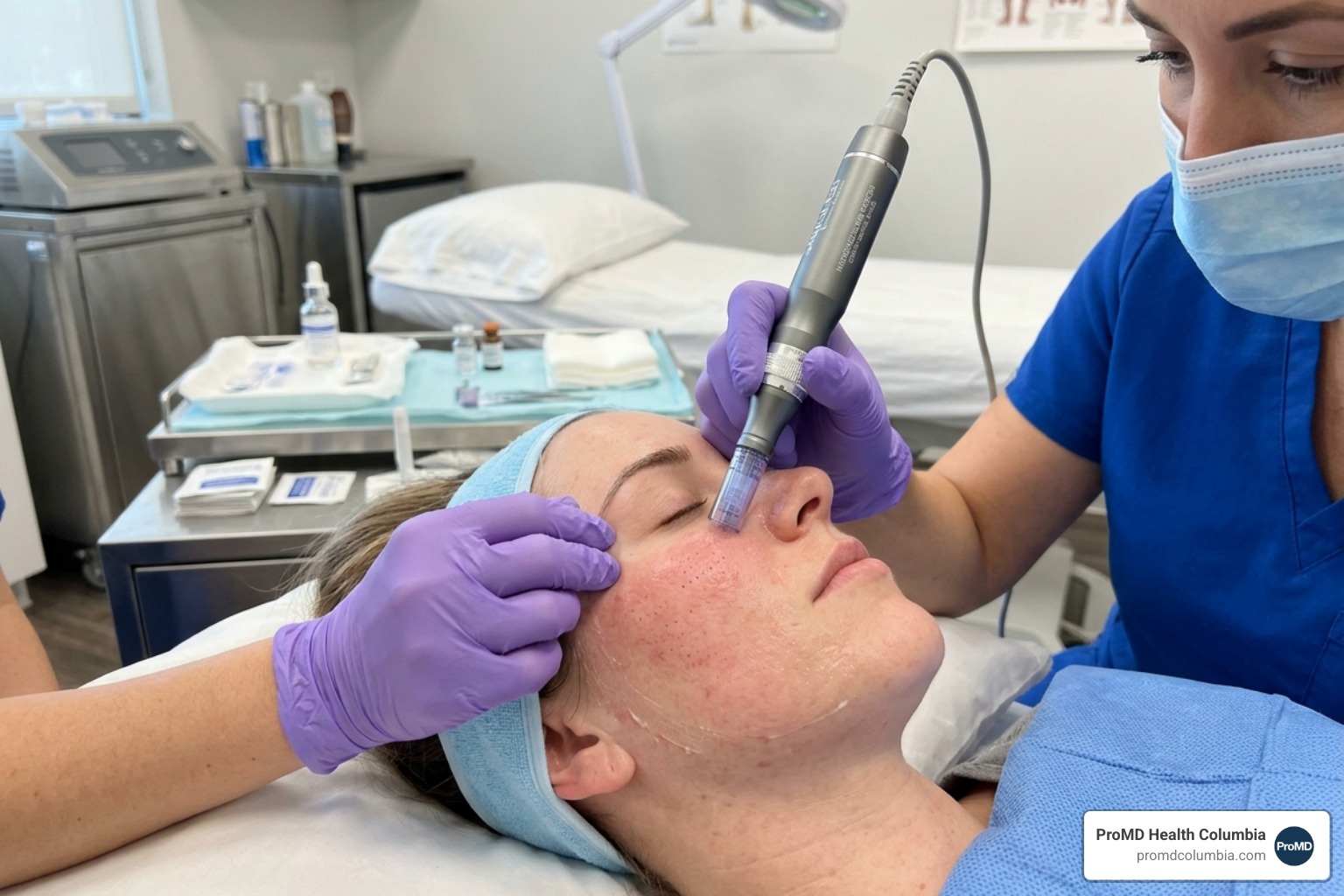
Microneedling, also known as collagen induction therapy, is a regenerative skin treatment that we use to “reset” your skin’s behavior. Using a professional device like the SkinPen®, we create thousands of controlled micro-punctures in the skin.
Don’t let the word “injuries” scare you! These channels are microscopic and shallow, leaving the main structure of your skin intact while sending a loud signal to your brain: “Hey, we need some repairs over here!”
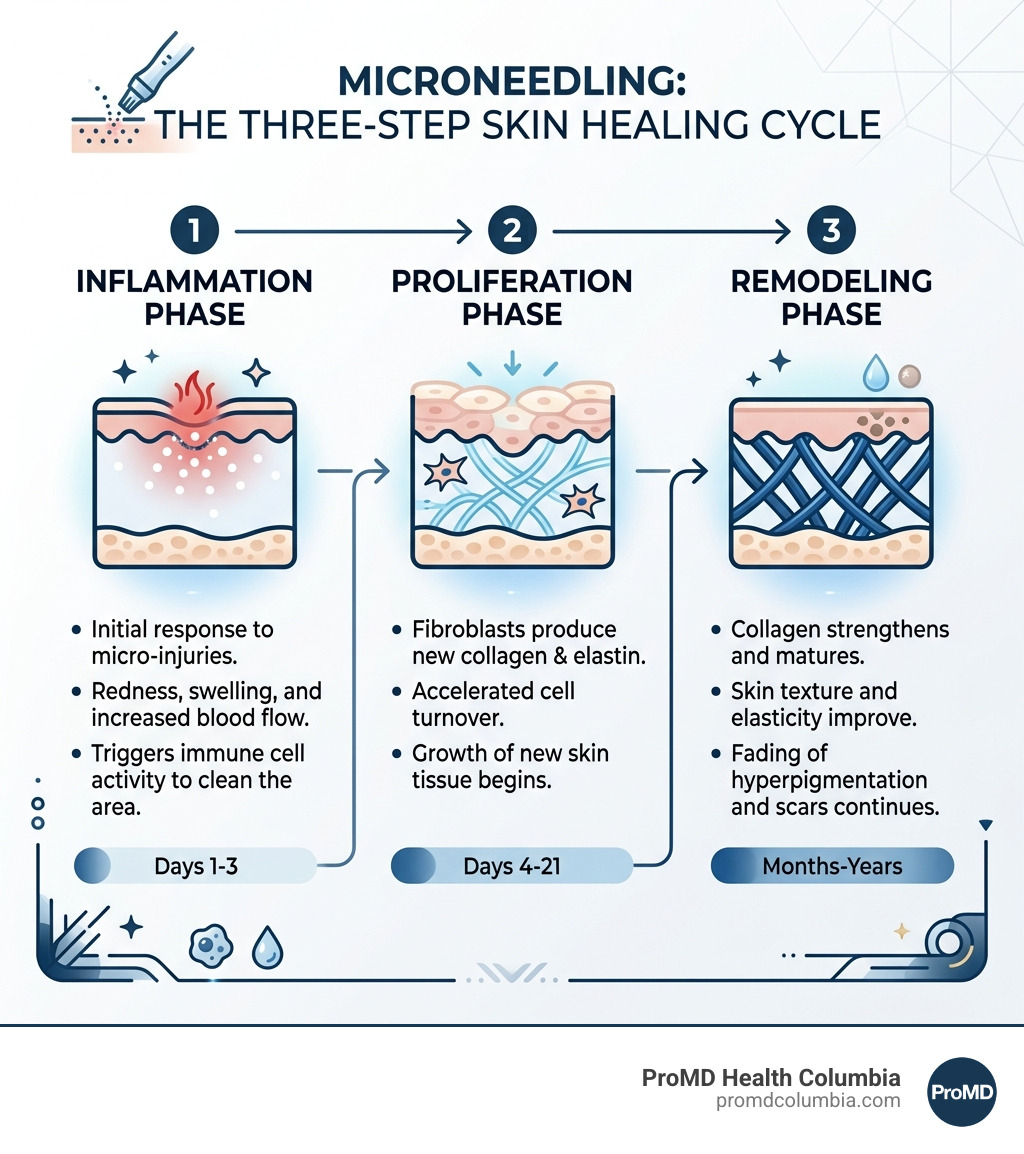
This triggers a three-step healing cascade:
- Inflammation: Your body sends growth factors to the site to clean up damaged tissue.
- Proliferation: New cells are born, and a fresh extracellular matrix is built.
- Remodeling: Fresh collagen and elastin replace old, damaged fibers.
For those of us in Howard County looking for microneedling services, this process is the key to evening out skin tone. It doesn’t just “burn off” the top layer; it remodels the skin from the inside out.
Disrupting Melanin Clusters with Microneedling for Hyperpigmentation
One of the coolest things about microneedling for hyperpigmentation is how it physically interacts with pigment. When hyperpigmentation occurs, melanin often sits in “clusters” or clumps. The physical action of the needles helps to mechanically break up these clusters.
By stimulating rapid cell turnover, we are essentially forcing the skin to shed those melanin-heavy cells faster and replace them with new, evenly pigmented cells. Furthermore, research suggests that microneedling helps regulate melanocyte activity, preventing them from overproducing pigment in the first place.
Enhancing Serum Absorption with Microneedling for Hyperpigmentation
Think of your skin like a brick wall. Most of the expensive brightening serums you buy at the store just sit on top of the bricks. Microneedling creates temporary “tunnels” through that wall.
Studies have shown that microneedling can increase the width of the follicular infundibulum (the pore opening) by up to 47%. This creates a massive opportunity to deliver depigmentation agents—like Vitamin C, Kojic Acid, Niacinamide, or Tranexamic Acid—directly to the layers where the pigment is actually formed. When we combine the physical disruption of the needles with high-potency serums, the results are significantly more dramatic than using topicals alone.
Safety and Efficacy Across All Skin Tones
One of the biggest hurdles in aesthetic medicine has historically been treating darker skin tones (Fitzpatrick types IV-VI). Many traditional lasers work by targeting pigment with heat. The problem? The laser can’t always tell the difference between the “bad” pigment (the dark spot) and the “good” pigment (your natural skin tone). This can lead to burns or even worse hyperpigmentation.
Because microneedling for hyperpigmentation is a mechanical process rather than a thermal (heat-based) one, it is significantly safer for our patients with darker skin in Clarksville and Laurel. Research has shown that microneedling provides statistically significant improvement in post-acne hyperpigmentation in darker skin types without the high risk of PIH associated with lasers.
If your skin is particularly sensitive or prone to darkening after irritation, we might suggest starting with a gentler approach like a HydraFacial to prep the skin barrier before moving into a series of microneedling sessions.
The Treatment Journey: Preparation to Aftercare
When you visit us at ProMD Health Columbia, we don’t just jump into the treatment. We want to ensure your skin is ready to heal beautifully.
Before your session:
- Stop the Actives: Put away your Retin-A, AHAs, and BHAs for at least 3-5 days before your appointment to avoid unnecessary irritation.
- Sun Protection: Avoid tanning or significant sun exposure for a week prior.
- Clean Slate: Arrive with a clean face, though we will provide a thorough medical-grade cleansing once you’re here.
During the procedure: We apply a high-strength lidocaine numbing cream for 30–45 minutes. Most of our patients describe the sensation as a light vibration or “cat-tongue” scratchiness—not painful! The actual needling takes about 15–30 minutes.
Aftercare: Your skin will look like you have a mild sunburn for about 24–48 hours. You might experience some dryness or “flaking” on day 3 or 4—this is the old, pigmented skin making way for the new!
| Feature | Microneedling | Laser (e.g., Halo/BBL) | Chemical Peels |
|---|---|---|---|
| Mechanism | Mechanical micro-injury | Light/Heat energy | Chemical exfoliation |
| Downtime | 1–2 days | 3–7 days | 3–7 days |
| Pain Level | Low (with numbing) | Moderate | Low to Moderate |
| Dark Skin Safety | High | Variable/Caution | Moderate |
| Primary Goal | Texture & Pigment | Pigment & Deep Wrinkles | Surface Pigment |
Maximizing Results with Combination Therapies
While standalone microneedling is powerful, we often see the “wow” results when we combine it with other modalities.
Microneedling with PRP (Platelet-Rich Plasma): Often called the “Vampire Facial,” this involves taking a small sample of your own blood, spinning it down to concentrate the platelets, and applying those growth factors back into the micro-channels created by the needles. PRP acts like “super-fuel” for the healing process, significantly speeding up the fading of dark spots. We highly recommend microneedling with PRP for patients with stubborn melasma or deep acne scarring.
The TCA “Boost”: For certain types of hyperpigmentation, specifically around the eyes (periorbital hyperpigmentation), studies have achieved marked improvements by combining microneedling with low-concentration TCA peels. The needles allow the peel to penetrate more evenly, leading to a brighter, more refreshed look.
Frequently Asked Questions about Microneedling for Hyperpigmentation
How many sessions are needed for noticeable results?
While your skin will look “glowy” within a week of your first session, true pigment correction takes time. We typically recommend a series of 3 to 6 sessions spaced 4 to 6 weeks apart. This timeline respects your skin’s natural 28-day renewal cycle and allows collagen to mature.
Is there significant downtime after the procedure?
Not at all! This is one of the reasons microneedling is so popular in the Columbia area. Most patients experience redness (erythema) and slight swelling (edema) for about 24 hours. You can usually return to work the next day and apply makeup after 24 hours. By day two or three, any “pinkness” is usually gone, replaced by a healthy radiance.
Can microneedling make melasma or dark spots worse?
If done improperly (too deep, too aggressive, or without sun protection), any treatment can cause inflammation that leads to more pigment. This is why it is vital to see experts like Jennifer Aponte, PA-C, or Sabina Sambat, NP. We use precise needle depths (usually 0.5mm to 1.5mm for pigment) and emphasize strict post-treatment SPF use to ensure your results are positive and lasting.
Conclusion
Hyperpigmentation doesn’t have to be a permanent fixture on your face. Whether you’re dealing with the remnants of summer sun or the stubborn patches of melasma, microneedling for hyperpigmentation offers a safe, effective, and minimally invasive path to a clearer complexion.
At ProMD Health Columbia, our team—including Daisey Cormier, NP, Jennifer Nicholson, Jessica Windsor, Stephanie Aponte, and Amaya Roeder—is dedicated to creating a customized plan that fits your skin’s unique needs. We even offer the Entity Med AI Simulator, allowing you to preview your potential results before we even begin.
Ready to see what your skin could look like without the dark spots? Schedule a consultation for microneedling at our Columbia, MD office today. We can’t wait to help you glow!

