

Why Your Immune System May Need More Than Vitamins
Peptide therapy immune support is one of the most targeted, science-backed approaches available today for people who want to strengthen their body’s natural defenses — especially as they age.
Here’s a quick overview of what it involves:
- What it is: The use of specific short-chain amino acid sequences (peptides) to signal and regulate immune system activity
- How it works: Peptides act as cellular messengers, activating T-cells, modulating inflammation, and supporting both innate and advanced immunity
- Key peptides used: Thymosin Alpha-1 (TA-1), LL-37, BPC-157, and Thymosin Beta-4
- Who it’s for: Adults experiencing frequent illness, chronic conditions, age-related immune decline, or post-viral fatigue
- How it’s given: Primarily via subcutaneous injection, under medical supervision
- Safety: Generally well-tolerated, with a strong safety profile when administered by a qualified provider
Your immune system doesn’t slow down all at once. It happens gradually — more colds that linger, slower recovery, a general sense that your body isn’t bouncing back the way it used to.
For many women in their 40s, this shift coincides with hormonal changes, increased stress, and a busier-than-ever lifestyle. Standard supplements like vitamin C or zinc can help at the margins. But they work differently than peptides.
Vitamins fuel the immune system. Peptides actually direct it.
The human body naturally produces over 7,000 known peptides that regulate everything from hormone production to tissue repair to immune defense. The problem? Peptide production declines with age — and that decline has real consequences for how well your immune system responds to threats.
Peptide therapy is designed to restore that signaling capacity, giving your immune cells the precise instructions they need to function at their best.
Understanding Peptides and Their Role in Immune Health
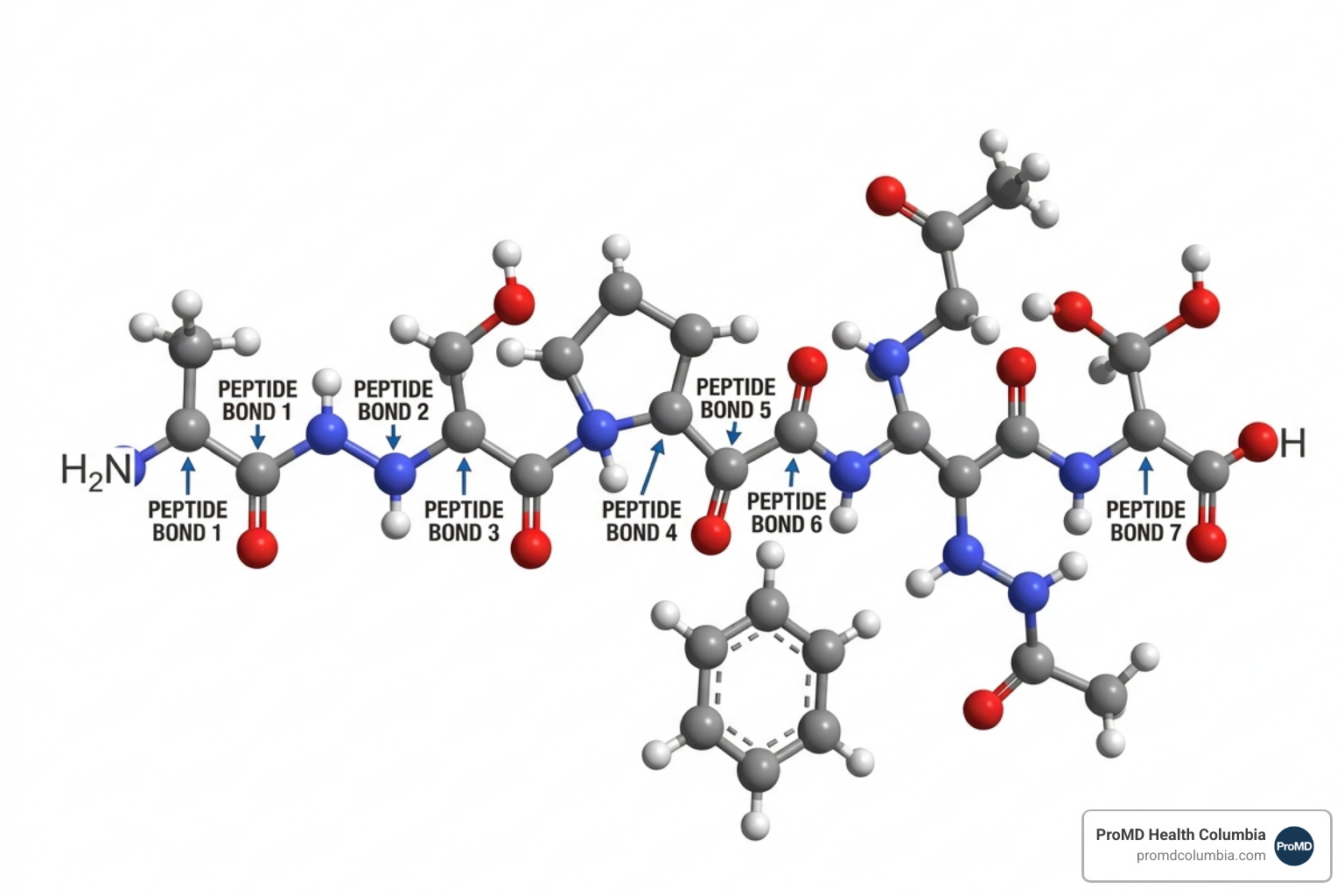
To understand how we use peptides at ProMD Health Columbia, it helps to start with the basics. You have likely heard that amino acids are the “building blocks” of life. When these amino acids link together in short chains—typically between 2 and 50 units—they form a peptide.
Amino Acids: The Foundation
Think of amino acids as individual letters in an alphabet. When you string a few letters together, you get a word (a peptide). When you string hundreds of letters together into complex structures, you get a book (a protein).
Protein vs. Peptide
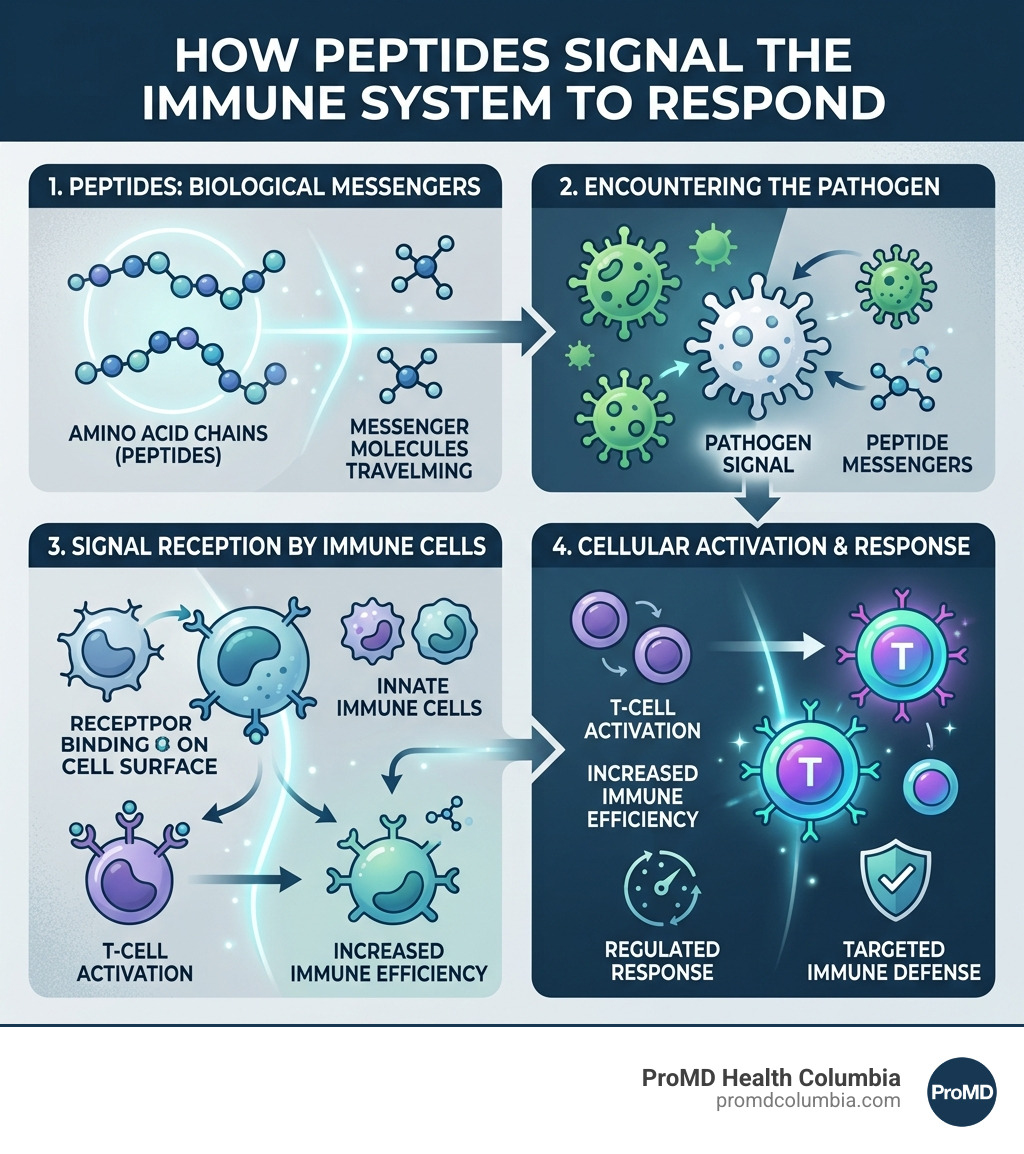
The primary difference between a peptide and a protein is size and complexity. Peptides are shorter, which often makes them easier for the body to absorb and utilize. Because they are smaller, they can penetrate tissues more effectively and bind to specific receptors on the surface of cells to trigger a response.
Molecular Signaling and Biological Messengers
Peptides function as biological messengers. They don’t just sit there; they “talk” to your cells. In the context of your immune system, they act like a high-tech communication network. They tell your body when to produce more white blood cells, when to dial down inflammation, and how to identify an invading virus versus a healthy cell.
How Peptide Therapy Immune Support Works
When we talk about peptide therapy immune support, we are referring to the therapeutic use of these messengers to optimize the body’s internal “software.”
Immune Modulation
One of the most significant benefits of peptides is their ability to provide immune modulation. Unlike some traditional medications that might broadly suppress the immune system (which can be dangerous), peptides help balance it. If your immune system is underactive, peptides can “turn it up.” If it is overactive—as seen in autoimmune conditions—certain peptides can help “turn it down” or promote tolerance.
T-Cell Activation and Killer T-Cells
Your immune system relies heavily on T-cells. These are the “soldiers” of your adaptive immune response.
- Helper T-cells coordinate the attack.
- Killer T-cells (cytotoxic T-cells) find and destroy cells that have been hijacked by viruses or have become cancerous.
Peptides, particularly those derived from the thymus gland, are essential for the maturation and activation of these cells. Without proper peptide signaling, your T-cell army might be present, but they won’t know how to fight.
Innate vs. Adaptive Response
Your immune system has two branches: the innate (immediate, non-specific defense) and the adaptive (learned, specific defense). Bioactive peptides bridge the gap between these two, ensuring that your body reacts quickly to a new threat while also building long-term memory to prevent future infections.
Thymosin Alpha-1: A Powerhouse for Peptide Therapy Immune Support
If there is a “gold standard” in immune-focused peptides, it is Thymosin Alpha-1 (TA-1).
Originally isolated from the thymus gland—a small organ behind your breastbone that is the “schoolhouse” for T-cells—TA-1 is a naturally occurring peptide that plays a critical role in immune function and T-cell maturation.
As we age, the thymus gland shrinks (a process called involution), and our natural production of TA-1 drops. This is a major reason why we become more susceptible to illness as we get older. By reintroducing TA-1 through peptide therapy immune support, we can:
- Enhance Viral Defense: TA-1 has been used globally to support the treatment of chronic hepatitis B and C, and was even studied for its ability to enhance vaccine efficacy during the H1N1 pandemic.
- Boost Natural Killer (NK) Cell Activity: These cells are your first line of defense against tumors and virally infected cells.
- Balance Cytokines: It helps regulate the “messengers” of inflammation, preventing the “cytokine storms” that can cause systemic damage.
Comparing Peptides to Traditional Immune Supplements
At ProMD Health Columbia, we often see patients who are already taking a handful of vitamins. While we support a healthy foundation of nutrition, it is important to understand why peptides offer a different level of precision.
| Feature | Oral Vitamins/Supplements | Peptide Therapy |
|---|---|---|
| Mechanism | Provide raw materials/fuel | Act as signaling messengers |
| Bioavailability | Often low (broken down by digestion) | High (direct to bloodstream) |
| Targeting | Broad/Systemic | Highly specific receptors |
| Speed of Action | Slow/Cumulative | Rapid cellular response |
| Precision | General support | Precision medicine |
Vitamins act like the gasoline in a car—you need them to run. Peptides act like the GPS and the engine control unit—they tell the car exactly where to go and how fast to move.
Key Peptides Used for Strengthening the Immune System
While TA-1 is the leader, several other peptides play vital roles in a comprehensive peptide therapy immune support plan.
BPC-157 (Body Protection Compound)
BPC-157 is a 15-amino acid peptide originally found in human gastric juice. While it is famous for its ability to heal tendons, muscles, and ligaments, its immune benefits are profound. It helps repair the “tight junctions” in the gut (addressing “leaky gut”). Since roughly 70-80% of your immune system resides in your gut, BPC-157 is a foundational tool for overall resilience.
Thymosin Beta-4 (TB4)
TB4 is another thymic peptide, but while TA-1 focuses on “command and control” of T-cells, TB4 is the master of tissue repair and inflammation reduction. It is often used after injury or surgery to speed up recovery and modulate the inflammatory response so the body can heal without excessive scarring or chronic pain.
LL-37
LL-37 is a “host defense peptide.” It has direct antimicrobial effects, meaning it can help neutralize bacteria, viruses, and fungi. It also helps recruit other immune cells to the site of an infection, acting like a flare gun that tells the rest of the immune system exactly where the trouble is.
For more information on the clinical foundation of these treatments, you can explore research on immune-related therapies.
Addressing Chronic Conditions with Peptide Therapy Immune Support
One of the most exciting aspects of peptide therapy is its application for complex, long-term health challenges.
- Lyme Disease and Co-infections: Peptides like TA-1 and LL-37 can help the immune system identify and attack persistent pathogens that have learned to “hide” from the immune system.
- Post-Viral Recovery: For those struggling with lingering fatigue or “brain fog” after a viral illness, peptides can help reset the inflammatory balance and restore energy.
- Autoimmunity: By promoting the production of Regulatory T-cells (Tregs), peptides can help “teach” the immune system to stop attacking the body’s own tissues.
- Multiple Sclerosis (MS): Research into MS and immune modulation has shown that specific peptides may help induce tolerance to myelin antigens, potentially slowing the progression of demyelinating diseases.
Proven Benefits and Clinical Applications
The real-world impact of peptide therapy immune support goes beyond laboratory data. Patients at our Columbia, MD office frequently report:
- Infection Resistance: Fewer seasonal colds and a shorter duration of illness if they do get sick.
- Reduced Systemic Inflammation: Less joint pain, better skin quality, and improved gut health.
- Faster Recovery: Whether it’s recovering from a grueling workout at a local Ellicott City gym or bouncing back from a surgical procedure.
- Enhanced Vitality: A general sense of “wellness” that comes when the body isn’t constantly bogged down by low-grade inflammation.
Scientific research on EAE models and autoimmunity continues to validate these observations, showing that peptides can effectively cross-talk with the nervous system to promote healing.
Safety, Administration, and What to Expect
We know that “injections” can sound intimidating, but the process is actually very simple and virtually painless.
Administration via Subcutaneous Injection
To ensure maximum bioavailability, most immune peptides are administered via a tiny needle into the fatty tissue (usually the abdomen), similar to an insulin shot. This allows the peptide to enter the bloodstream directly, bypassing the harsh environment of the stomach.
Dosage and Frequency
There is no “one size fits all” in peptide therapy. At ProMD Health Columbia, Jennifer Aponte, PA-C, Sabina Sambat, NP, and our team customize protocols based on your blood work and health goals. Some patients may use a peptide daily for a few weeks to “kickstart” their system, while others may cycle them on and off throughout the year.
Safety and Side Effects
Peptides are generally extremely safe because they mimic the sequences already found in your body. The most common side effect is slight redness or itching at the injection site. Because they are broken down into simple amino acids, they don’t place a heavy burden on the liver or kidneys like many synthetic drugs.
Regulatory Status
It is important to note the current landscape of peptide therapy. While over 100 peptide-based drugs are FDA-approved (like insulin or Ozempic), many others are used “off-label” or provided through high-quality compounding pharmacies. It is vital to get your peptides from a reputable medical provider to ensure purity and correct concentration. Interestingly, many of these same signaling pathways are used in collagen-stimulating peptides for skin health, showing how versatile these molecules are.
Frequently Asked Questions about Peptide Therapy
How long does it take to see immune-boosting results?
While every body is different, most patients begin to notice shifts in their energy levels and inflammatory markers within 4 to 8 weeks of consistent use. For acute support during a cold, some peptides can provide a noticeable boost in just a few days.
Can peptide therapy be combined with IV hydration?
Absolutely. In fact, we often recommend this! Our IV hydration therapies provide the essential vitamins and minerals (the “fuel”) while the peptides provide the “instructions.” This synergistic approach is one of the most effective ways to optimize your health.
Who is the ideal candidate for immune-focused peptides?
If you are over 30, experiencing frequent illness, dealing with a chronic inflammatory condition, or simply want to optimize your biological age, you are likely a great candidate. It is particularly beneficial for those in high-stress roles or those with a family history of autoimmune issues.
Conclusion
At ProMD Health Columbia, we believe that “getting older” shouldn’t mean “feeling weaker.” By utilizing the latest advancements in regenerative medicine, we help our patients in Columbia, Ellicott City, and Howard County take control of their biological health.
Whether you are looking to sharpen your immune defense with peptide therapy immune support, explore hormone therapy, or utilize our Entity Med AI Simulator to see the results of our aesthetic treatments, we are here to guide you.
Our team, including Jennifer Aponte, PA-C, Sabina Sambat, NP, Daisey Cormier, NP, and our dedicated staff, focuses on personalized wellness plans that actually work. Don’t settle for “normal for your age” when you can feel extraordinary.
Ready to strengthen your defenses?
Visit us at 8825 Stanford Blvd Suite 130, Columbia, MD 21045, or contact us today to schedule your consultation. Let’s give your immune system the messengers it needs to keep you thriving.

