

What Maryland Estheticians Can (and Cannot) Do With Microneedling Right Now
Can estheticians do microneedling in Maryland is one of the most searched — and most misunderstood — questions in the state’s skincare industry right now. Here is the short answer:
No — not yet, and not independently.
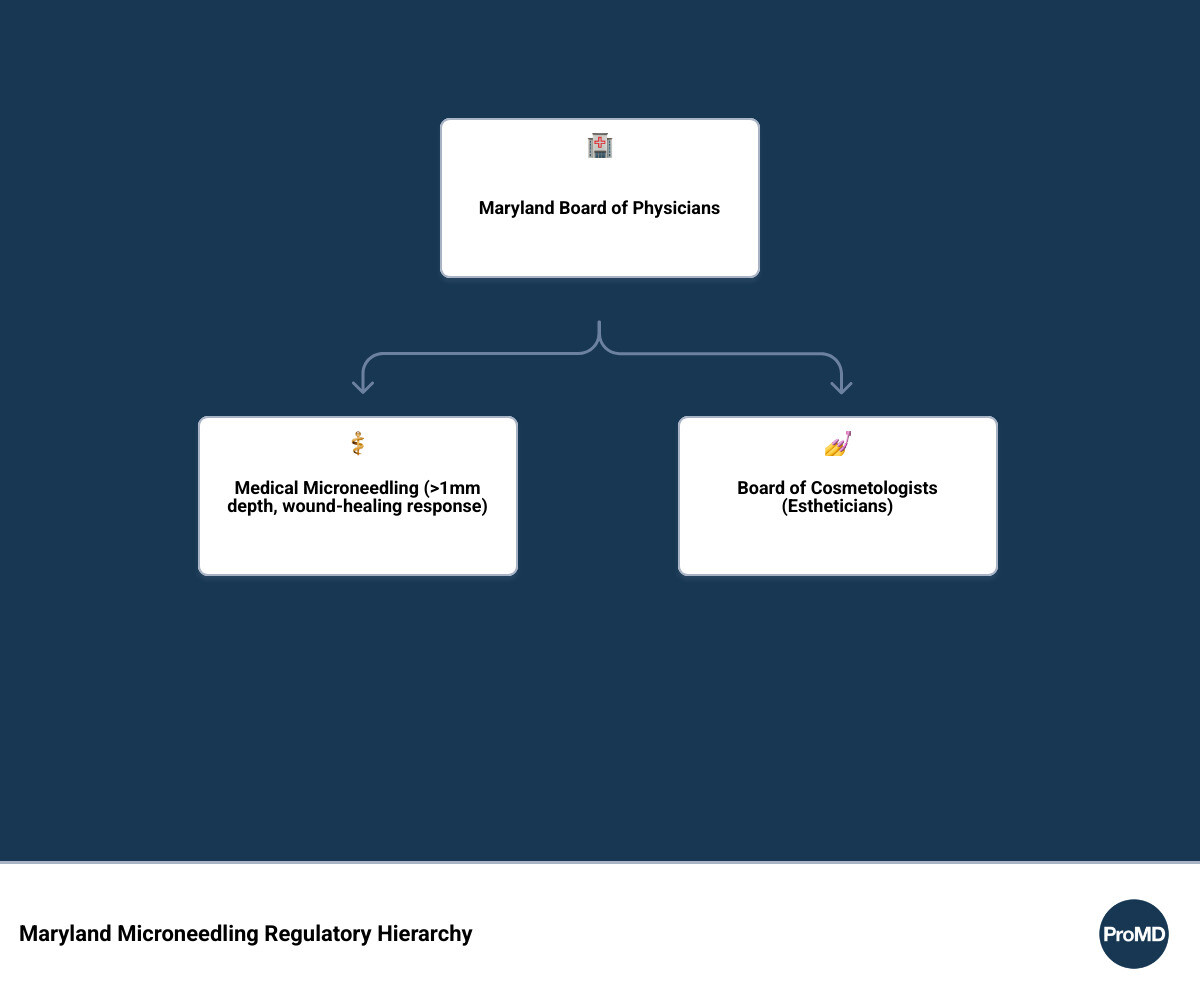
Under current Maryland regulations, microneedling is classified as a medical procedure when it penetrates deep enough to trigger a wound-healing response. That puts it outside the legal scope of practice for licensed estheticians performing services independently.
Here is a quick breakdown of where things stand:
| Who | Can They Do Microneedling in Maryland? |
|---|---|
| Licensed Esthetician (independent) | No — currently prohibited |
| Physician (MD/DO) | Yes |
| Certified Nurse Practitioner (CNP) | Yes |
| Physician Assistant (PA) | Yes |
| Registered Nurse (RN) | Yes, under supervision |
| Esthetician under proposed 2026 rules | Possibly — up to 1mm, cosmetic devices only |
The rules are changing. Maryland’s Board of Cosmetologists has proposed new regulations that would allow licensed estheticians to perform cosmetic microneedling using non-medical devices with needles no longer than 1mm, provided the needle does not penetrate beyond the epidermis. But those rules have not taken effect yet.
For patients in Columbia, MD seeking microneedling right now, the safest and most legally compliant option is to work with a licensed medical provider — not an esthetician working outside their current scope.
This guide breaks down the full picture: the current law, what’s changing, who can legally treat you today, and what to look for when choosing a provider.
Current Regulations: Can Estheticians Do Microneedling in Maryland?
Navigating aesthetic regulations in Maryland can feel a bit like trying to read a map in the dark. We often hear from clients in Howard County who are surprised to learn that their favorite facialist cannot legally perform microneedling at their local salon. To understand why, we have to look at how Maryland defines “medical acts.”
In Maryland, the Board of Physicians and the Board of Cosmetologists share the responsibility of keeping the public safe. Currently, the Maryland Board of Physicians classifies any procedure that involves the penetration of the skin to a depth that triggers a wound-healing response as a medical procedure. Because microneedling works by creating thousands of “micro-injuries” to stimulate collagen, it falls squarely into this category.
The Legal Status of Cosmetic Microneedling
The confusion often stems from the term “cosmetic.” While we think of microneedling as a beauty treatment, Maryland law looks at the mechanism of the device. If a device is intended to affect the structure or function of the body (like building new collagen in the dermis), it is generally viewed as a medical device.
According to Can An Esthetician Do Microneedling? State-by-State Rules, Maryland has historically been one of the stricter states. Unlike some neighboring regions where estheticians might perform superficial treatments, Maryland has maintained that estheticians are not healthcare practitioners. This means they cannot independently perform medical acts, regardless of how “cosmetic” the goal might be.
Can estheticians do microneedling in Maryland at superficial depths?
You might wonder, “What if the needles are really short?” Currently, even superficial microneedling (often defined as 0.25mm or 0.5mm) remains a gray area that leans toward “no” for independent estheticians. The Maryland Board of Physicians regulations (specifically Chapter 10.32.09) emphasize that cosmetic medical procedures—which include treatments that use a device to alter skin appearance—require a medical license.
While some states allow estheticians to use “cosmetic rollers” that don’t penetrate the living layers of the skin, Maryland’s current stance is that standard estheticians are limited to non-medical services like facials, waxing, and certain types of dermaplaning.
Medical vs. Cosmetic Microneedling: The 0.5mm Distinction
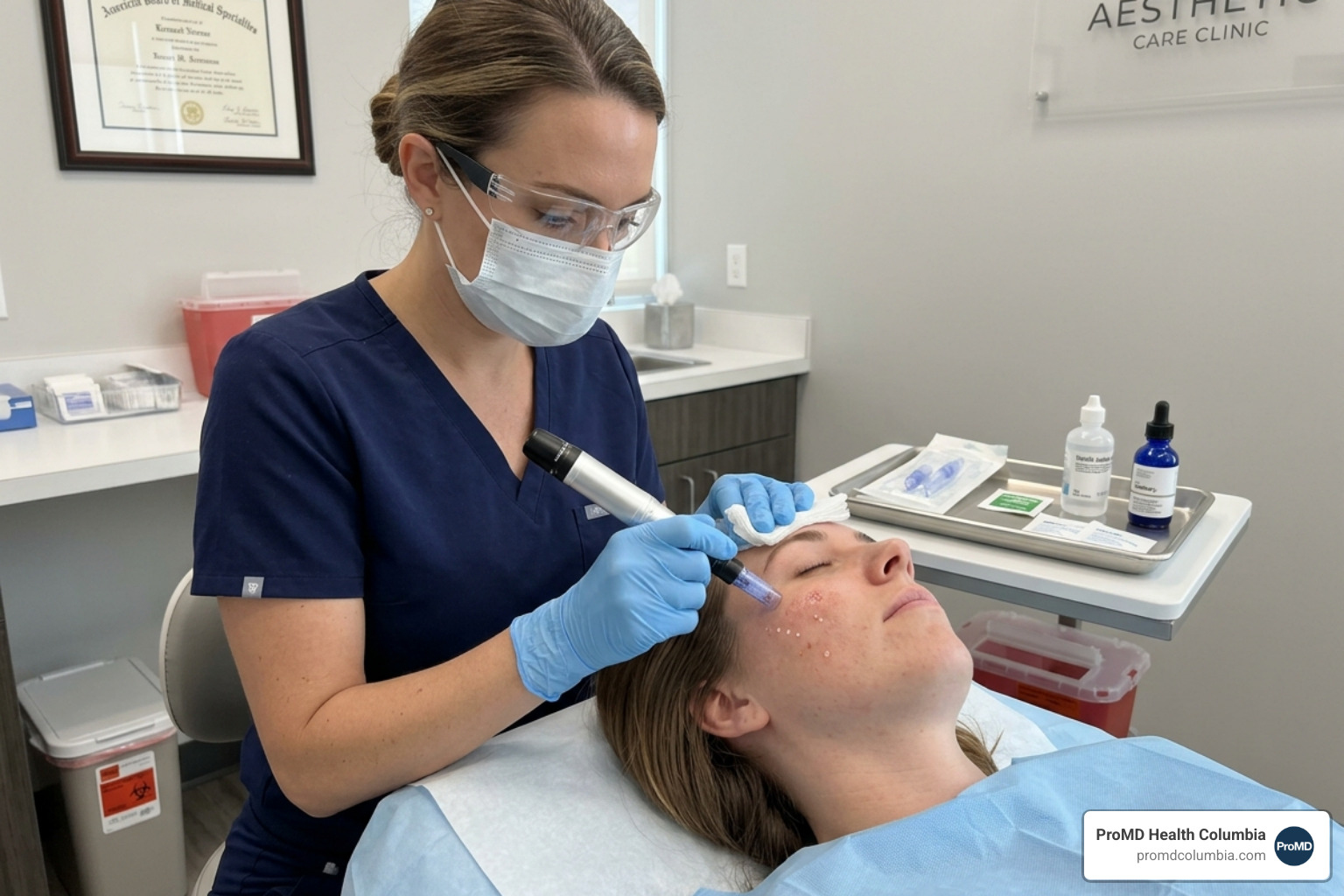
When we discuss microneedling at our Columbia office, we often talk about the difference between “medical-grade” and “cosmetic” depths. This isn’t just marketing jargon; it’s a biological distinction.
The 0.5mm Border
The skin is divided into the epidermis (the outer layer) and the dermis (the deeper layer where collagen lives). Generally, needles shorter than 0.5mm stay within the epidermis. This is often called “cosmetic microneedling.” Its primary goal is to increase the absorption of serums and brighten the skin’s surface.
Medical-grade microneedling typically uses needles ranging from 0.5mm to 2.5mm. These needles reach the dermis, where they can effectively treat acne scars, deep wrinkles, and skin laxity. In Maryland, anything reaching these depths is strictly a medical act.
| Feature | Cosmetic Microneedling | Medical-Grade Microneedling |
|---|---|---|
| Needle Depth | Usually < 0.5mm | 0.5mm to 2.5mm+ |
| Primary Goal | Product absorption, glow | Collagen induction, scar revision |
| Target Layer | Epidermis only | Dermis (living tissue) |
| Provider | Proposed for Estheticians (2026) | MD, PA, NP, RN |
| Bleeding | Minimal to none | Pinpoint bleeding expected |
For more details on the clinical side of these treatments, you can explore our microneedling services.
Clinical vs. Aesthetic Outcomes
The reason we prioritize medical-grade treatments is the results. While a 0.25mm needle might make your skin look refreshed for a few days, it isn’t going to fix a deep-set acne scar. To get structural remodeling of the skin, you need to reach the fibroblasts in the dermis. This requires professional supervision and medical-grade technology, such as the SkinPen or VirtueRF systems we utilize.
Safety and Infection Control
Safety is the biggest reason these regulations exist. Microneedling involves needles and, often, pinpoint bleeding. This creates a risk for bloodborne pathogen transmission if not handled in a sterile, clinical environment. At ProMD Health Columbia, we follow strict OSHA standards, using single-use, sterile cartridges and medical-grade sanitization protocols that go far beyond what a typical day spa is equipped to handle.
Proposed Rule Changes and the 2026 Timeline
If you are an esthetician or a fan of skincare, you may have heard whispers that the rules are changing. This is true! The Maryland Board of Cosmetologists has been working on a significant “modernization” of the scope of practice for beauty professionals.
Future outlook for can estheticians do microneedling in Maryland
According to A First Look at Maryland’s Proposed Rules, the Board of Cosmetologists issued proposed rules that would add “cosmetic microneedling” to the Esthetician License category.
The key points of the proposal include:
- Needle Depth: Estheticians would be allowed to use needles no longer than 1.0mm.
- Penetration Limit: The needles must not penetrate beyond the epidermis.
- Device Type: Only “cosmetic, non-medical devices” would be permitted.
- Timeline: While discussions are ongoing, many of these changes—including new licensing for eyelash technicians—are aimed toward a 2026 implementation.
This is a big step for the industry, potentially opening up new revenue streams for small businesses in Ellicott City and Clarksville. However, until these rules are finalized and officially added to the Maryland Register, the current “medical only” restrictions remain in place.
New Training and Certification Requirements
The proposed rules aren’t a “free-for-all.” Estheticians will likely be required to complete specific Board-approved training, pass practical examinations, and adhere to strict new sanitation protocols. This ensures that as the scope expands, patient safety remains the top priority.
Who Can Legally Perform Microneedling in Maryland Med Spas?
So, who can you see today for a treatment in Columbia? Because microneedling is currently a medical act, the provider must be a licensed healthcare professional.
The Qualified Team
At a medical spa like ProMD Health Columbia, your treatment is performed or supervised by:
- Physicians (MD/DO): The ultimate authority on medical treatments.
- Physician Assistants (PA-C): Such as Jennifer Aponte, PA-C, who can evaluate patients and perform medical procedures.
- Nurse Practitioners (NP): Like Sabina Sambat, NP or Daisey Cormier, NP, who have advanced medical training to prescribe and perform these treatments.
- Registered Nurses (RN): Who can perform the procedure under the delegation and supervision of a physician.
Delegation and Supervision Protocols
Maryland law is very specific about how these procedures are delegated. A physician (or a qualified NP/PA) must first perform an initial evaluation of the patient. They must obtain informed consent and ensure the patient is a good candidate for the treatment.
One of the most important rules in Maryland is the “physician presence” requirement for certain cosmetic medical procedures. While an RN can perform the actual needling, a medical director must be involved in the clinical oversight of the practice.
For those interested in other advanced treatments, we also offer medical-grade chemical peels, which similarly require professional medical oversight to ensure the acids used are safe for your specific skin type.
Compliance, Supervision, and the Corporate Practice of Medicine
You might wonder why Maryland is so much stricter than some other states. A lot of it comes down to the Corporate Practice of Medicine (CPOM) doctrine.
In Maryland, a medical practice (including a med spa) must generally be owned by a licensed physician. This prevents non-medical corporations from making clinical decisions that should be left to doctors. This is why “management service organizations” (MSOs) are common—they handle the business side, while a physician-owned entity handles the medicine.
Avoiding Scope of Practice Violations
When an esthetician performs microneedling independently in Maryland right now, they are technically practicing medicine without a license. The penalties for this are severe:
- Cease-and-Desist Orders: The state can shut down the business immediately.
- Administrative Fines: These can reach thousands of dollars.
- License Revocation: Both the esthetician and the supervising physician (if they improperly delegated the task) can lose their professional licenses.
Ensuring Patient Safety in Columbia
At ProMD Health Columbia, we don’t take these rules lightly. We believe that rigorous oversight is essential for patient safety. When you visit us at 8825 Stanford Blvd Suite 130, you aren’t just getting a beauty treatment; you are receiving medical-grade care.
We use our Entity Med AI Simulator to help you preview your results, ensuring that your customized treatment plan is both safe and effective. Whether you are coming in for microneedling or Botox and Dysport, you can rest easy knowing your provider is operating fully within their legal scope of practice.
Frequently Asked Questions about Maryland Microneedling
What is the current needle depth limit for Maryland estheticians?
Currently, there is no “safe” depth that allows an esthetician to work independently. Maryland classifies microneedling as a medical act if it triggers a wound-healing response. However, the proposed 2026 rules suggest a future limit of 1.0mm for estheticians using cosmetic, non-medical devices, provided they stay within the epidermis.
Can an esthetician perform microneedling if a doctor is on-site?
In Maryland, the Board of Physicians typically restricts the delegation of medical acts to other healthcare providers (like PAs, NPs, or RNs). Because estheticians are governed by the Board of Cosmetologists and are not classified as healthcare practitioners, most medical directors will not delegate medical-grade microneedling to them to avoid compliance issues.
What are the penalties for non-compliant microneedling in Maryland?
Practices found to be operating outside their scope can face heavy fines, permanent cease-and-desist orders, and the revocation of professional licenses. For the consumer, the risk is even higher: treatments performed by untrained or unauthorized providers carry a much higher risk of infection, scarring, and poor results.
Is microneedling safe for all skin tones?
Yes! One of the reasons we love microneedling at ProMD Health Columbia is that it is generally safe for all skin types and colors. Unlike some lasers that target pigment, microneedling creates physical channels, making it a great option for patients with darker skin tones who want to treat scarring or texture issues without the risk of hyperpigmentation.
How many sessions will I need?
While you might see a “glow” after just one visit, most patients in Columbia see the best results after a series of 3 to 6 sessions, spaced about 4 to 6 weeks apart. This timeline allows your body to build new collagen and elastin between treatments.
Conclusion
The question of can estheticians do microneedling in maryland is a moving target. While the laws are shifting toward allowing more flexibility for beauty professionals by 2026, the current legal landscape requires a medical license to perform these treatments safely and legally.
At ProMD Health Columbia, our team—including Jennifer Aponte, PA-C, Sabina Sambat, NP, and Daisey Cormier, NP—is dedicated to providing the highest level of clinical excellence. We combine the latest medical technology with a warm, patient-centered approach to help you achieve your best skin yet.
Don’t leave your face to chance. Ensure your provider has the medical credentials required by Maryland law to give you the results you deserve.
Ready to start your journey to smoother, more radiant skin? Schedule a professional Microneedling consultation with our expert team in Columbia today!

