

Large Pores Got You Down? Here’s What Microneedling Can Actually Do
Microneedling for large pores is one of the most effective non-surgical ways to refine skin texture and reduce the visible size of enlarged pores — and the science backs it up.
Quick answer: Microneedling stimulates collagen and elastin production by creating tiny, controlled micro-injuries in the skin. This tightens the tissue around pore walls, making pores appear significantly smaller. It doesn’t permanently eliminate pores (nothing does), but multiple sessions produce real, lasting improvement.
What to know at a glance:
| Question | Short Answer |
|---|---|
| Does it work? | Yes — visible pore reduction after a series of sessions |
| How many sessions? | Typically 3-6, spaced 4-6 weeks apart |
| How soon do results show? | Initial improvement in 2-4 weeks; full results over months |
| Is it safe for all skin types? | Yes — unlike some lasers, microneedling works across all tones |
| Downtime? | Minimal — redness fades within 24-48 hours |
| Does it permanently shrink pores? | No — it makes them look smaller by firming surrounding skin |
If you’ve ever caught yourself in a magnifying mirror and felt your pores looked enormous — you’re not alone. It’s one of the most common skin concerns we hear at ProMD Health Columbia, especially from women noticing changes in their skin texture as they get older.
The frustrating truth? Pores don’t open and close. They can’t be scrubbed away. And no filter exists in real life.
But here’s the good news: there’s a treatment that actually addresses what’s happening beneath the surface — not just on top of it.
This guide walks you through everything you need to know about using microneedling to tackle large pores — how it works, what results to expect, how many sessions you’ll need, and how it stacks up against other options.
Understanding the Root Causes of Enlarged Pores
Before we dive into the “how” of the treatment, we need to talk about the “why.” Why do some of us have pores that seem to “steal the spotlight” every time we look in the mirror?
Pores are actually the openings of hair follicles and sebaceous glands. They are essential for our skin health because they allow sweat and sebum (oil) to reach the surface, keeping our skin hydrated and protected. However, several factors can cause them to become more prominent:
- Genetics: This is the biggest factor. Just like your eye color, your pore size is largely determined by your DNA.
- Excess Sebum: When your skin produces too much oil, it can mix with dead skin cells and debris, clogging the pore. This “plug” stretches the pore opening, making it look much larger.
- Aging and Collagen Loss: As we age, our production of collagen and elastin—the proteins that keep skin firm and bouncy—slows down. Without this structural support, the “walls” of your pores begin to sag, making the openings appear wider and more oval-shaped.
- Sun Damage: Years of UV exposure break down collagen even faster. This loss of elasticity is a leading cause of sagging skin, which directly contributes to visible pores.
- Environmental Pollutants: Dirt and grime from the environment can settle into pores, leading to inflammation. Inflamed skin often makes pores look more pronounced.
According to the Dermatologist guide to large facial pores, keeping pores clear and protecting your skin from the sun are the first steps in management. But for those of us in Columbia, MD, dealing with the humidity of Maryland summers or the natural aging process, topical creams often aren’t enough to tighten that skin back up.
How Microneedling for Large Pores Works its Magic
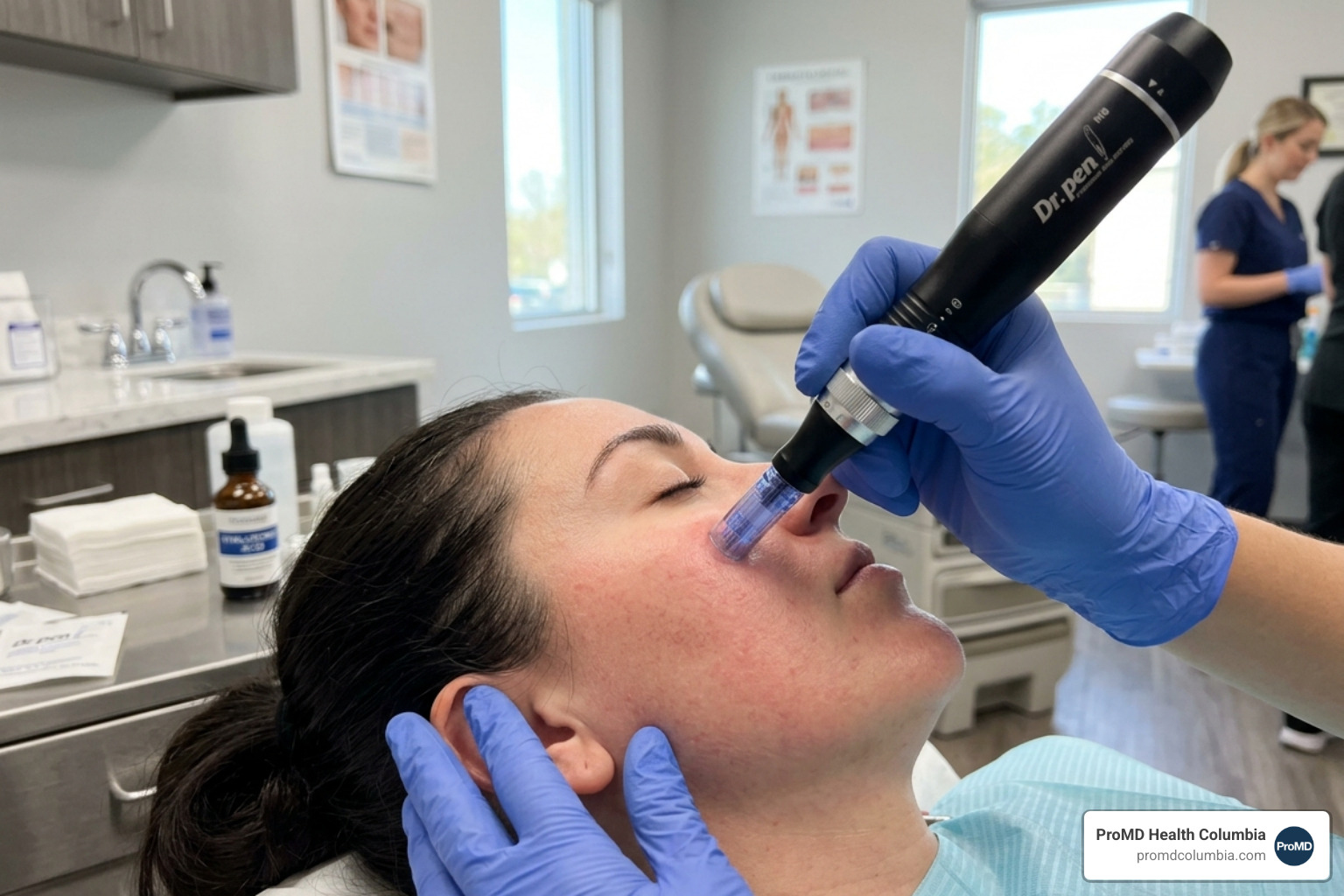
Microneedling, also known as Collagen Induction Therapy (CIT), is a minimally invasive procedure that uses a professional-grade device equipped with tiny, sterile needles. At ProMD Health Columbia, we use advanced technology to ensure precision and safety.
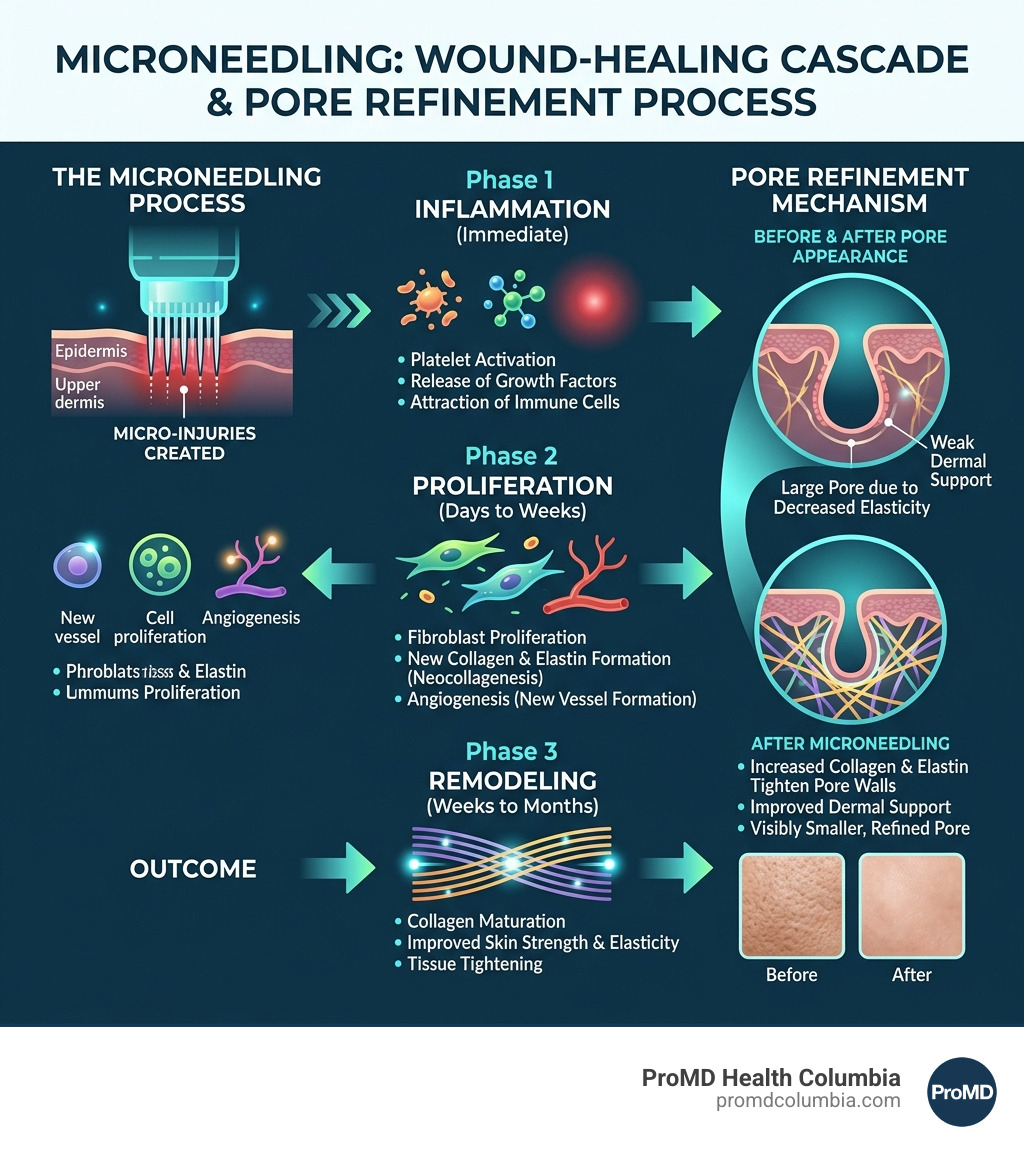
The process is fascinating. As the needles move across the skin, they create thousands of microscopic “micro-injuries.” Your body, being the incredible machine it is, perceives these tiny punctures as wounds that need fixing. This triggers a natural wound-healing response:
- Inflammation: Immediately after the needles touch the skin, the body sends platelets and white blood cells to the area.
- Proliferation: The skin begins to rebuild itself. This is where the magic happens—your body ramps up the production of new collagen and elastin.
- Remodeling: Over the following weeks, this new collagen matures and strengthens the dermal layer.
This process of collagen remodeling is key. By thickening the dermis and providing better support to the pore walls, the skin becomes firmer and more “taut.” Scientific research on microneedle radiofrequency efficacy has shown that these treatments are particularly effective at improving skin texture and reducing the appearance of enlarged pores across different facial sites, including the nose, forehead, and cheeks.
Does Microneedling for Large Pores Actually Shrink Them?
It’s time for a little “myth-busting.” You might hear people say they want to “shrink” their pores. Technically, pores do not have muscles, so they cannot physically open or close like a door.
When we perform microneedling for large pores, we aren’t actually changing the genetic size of the pore. Instead, we are changing the structure of the skin around it. Imagine a pore as a hoop and the surrounding skin as a series of deflated balloons. When the skin lacks collagen, the hoop looks wide and unsupported. Microneedling “inflates” those surrounding balloons with fresh collagen, plumping the skin and tightening the frame around the hoop.
The result is a powerful optical illusion: the skin looks smoother, the “craters” are filled in, and the pores appear significantly smaller and less noticeable to the naked eye.
Enhancing Microneedling for Large Pores with PRP and Skincare
One of our favorite ways to level up your results at ProMD Health Columbia is by combining microneedling with Platelet-Rich Plasma (PRP), often called a “Vampire Facial.”
During this treatment, we take a small sample of your own blood, spin it in a centrifuge to concentrate the platelets, and then apply that nutrient-rich plasma back onto the skin during the microneedling process. Because the needles have created thousands of micro-channels, the PRP can penetrate deep into the dermis. These growth factors act like “fuel” for the collagen-building process, often leading to faster healing and even more dramatic pore refinement.
Beyond PRP, your home routine matters. Using ingredients like Salicylic Acid for pores can help keep them clear of oil and debris between sessions. We also often recommend medical-grade facials to maintain that “glass skin” glow. After your microneedling session, your skin is also primed to absorb high-quality serums—like hyaluronic acid or peptides—more effectively than ever before.
Professional Treatments vs. At-Home Devices
We get asked all the time: “Can’t I just use a derma-roller at home?” While the DIY spirit is great for home decor, it can be dangerous for your face. There is a massive difference between professional microneedling for large pores and at-home gadgets.
| Feature | Professional Microneedling | At-Home Derma-Rollers |
|---|---|---|
| Needle Depth | Adjustable (up to 2.5mm or more) to reach deep collagen | Very shallow (usually 0.25mm) |
| Safety | Sterile, single-use tips in a medical environment | High risk of infection and cross-contamination |
| Precision | Vertical delivery prevents “track mark” tearing | Rolling motion can cause micro-tearing of the skin |
| Device Quality | FDA-cleared medical devices (like SkinPen) | Unregulated, often dull or bent needles |
| Results | Dramatic, structural skin changes | Minimal, temporary surface smoothing |
At ProMD Health Columbia, our providers—including Jennifer Aponte, PA-C, and our expert NPs Sabina Sambat and Daisey Cormier—are trained to customize the needle depth based on your specific skin thickness and the area being treated (the skin on your nose is much different than the skin on your cheeks!). For more details on our medical standards, check out our professional microneedling services page.
What to Expect: Sessions, Results, and Recovery
If you’re looking for a “one and done” miracle, microneedling might not be it—but if you’re looking for real, sustainable change, it’s a gold mine.
The Timeline: Most of our patients see the best results for pore reduction after a series of 3 to 6 sessions, spaced about 4 to 6 weeks apart. This timing is crucial because it allows your skin’s natural renewal cycle to complete and for new collagen to mature.
The Experience: We apply a medical-grade numbing cream before the session, so most patients describe the feeling as a light, prickly vibration rather than pain. The actual needling usually takes about 20–30 minutes.
The Recovery: Immediately after, you’ll look like you have a mild sunburn (erythema) and perhaps some slight swelling (edema). This typically fades within 24 to 48 hours. By day three, most people are back to their normal makeup and skincare routines, though you’ll want to be extra diligent with sun protection!
The Results: You might notice a “glow” within a week, but the real pore-refining magic happens between weeks 4 and 12. As the collagen builds, you’ll notice your skin feels firmer and those “holes” on your nose and cheeks seem to fade into the background.
Comparing Microneedling to Other Pore-Refining Treatments
Microneedling is a fantastic “all-rounder,” but it’s not the only tool in our kit. How does it compare to other popular treatments?
- Chemical Peels: These are excellent for dissolving the “glue” that holds dead skin cells together. While professional chemical peels are great for clearing out clogged pores and brightening the surface, they don’t always provide the same deep structural “lift” that microneedling does.
- Laser Resurfacing (Halo or BBL): Lasers use light energy to target skin concerns. They can be incredibly powerful for pigment and deep wrinkles. However, microneedling is often preferred for patients with darker skin tones because it doesn’t use heat, which minimizes the risk of post-inflammatory hyperpigmentation.
- Dermaplaning: This is a physical exfoliation that removes “peach fuzz” and dead skin. While it makes your skin feel incredibly soft, you can learn more info about dermaplaning to see that it’s more of a surface-level prep than a deep collagen-builder.
Often, the best approach is a combination. For example, clearing the pores with a peel or HydraFacial and then following up with microneedling to tighten the skin is a “holy grail” combo for many of our Columbia patients.
Frequently Asked Questions about Microneedling for Pores
How many sessions are typically needed for noticeable pore improvement?
For most patients, 3 to 6 sessions are the sweet spot. While you might see a brighter complexion after just one visit, pore refinement requires structural changes in the skin. Because collagen maturation takes time, the results are cumulative—each session builds on the last.
Is microneedling safe for all skin types and tones?
Yes! One of the biggest benefits of microneedling is that it is “color-blind.” Unlike some older laser technologies that can be risky for deeper skin tones (higher on the Fitzpatrick scale), microneedling does not use heat. This makes it a very safe and effective option for almost everyone, provided there are no active skin infections or inflamed acne in the treatment area.
What is the typical downtime after a session?
Downtime is minimal. Most patients experience redness for 24 to 48 hours. We recommend avoiding intense workouts, saunas, and direct sun exposure for the first few days. Once the initial redness subsides, you may experience some very light peeling, which is just your skin shedding the old cells to make way for the new.
Conclusion
If you’re tired of trying to hide your pores under heavy primers and foundations, it’s time to try a treatment that works with your body’s natural healing power. Microneedling for large pores isn’t just a trend; it’s a scientifically-backed method for achieving smoother, firmer, and more radiant skin.
At ProMD Health Columbia, we don’t believe in one-size-fits-all beauty. Our team—led by Jennifer Aponte, PA-C, and our dedicated nurse practitioners—takes the time to understand your skin goals and create a customized plan just for you. Whether you’re coming from Ellicott City, Clarksville, or right here in Columbia, we’re here to help you feel confident in your own skin.
Ready to see the difference for yourself? Schedule your microneedling consultation today at our Howard County office and take the first step toward a “pore-less” glow. We can’t wait to see you!

