

If you've been staring at lip filler before and after photos and thinking, “Some of these look amazing, and some look nothing like what I want,” you're not alone. Many individuals don't struggle with the idea of fuller lips. They struggle with the uncertainty. Will the result look soft or overdone? Will it match your face? And when you see an “after” photo online, is that the final result or just a swollen one?
That confusion is normal. Lip filler is one of the most requested aesthetic treatments because it can create beautiful changes with small adjustments. But the photo you see on your phone usually leaves out the part that matters most: healing, technique, anatomy, and timing.
A better way to look at lip filler before and after images is to treat them like part of a story, not the whole story.
Table of Contents
- The Truth Behind Lip Filler Before and After Photos
- Your Lip Filler Healing Timeline Day by Day
- What Truly Shapes Your Final Lip Filler Results
- Real Patient Results from ProMD Health Columbia
- Lip Filler Aftercare Longevity and Safety
- Preview Your Look with the Entity Med AI Simulator
- How to Prepare for Your Lip Filler Consultation
The Truth Behind Lip Filler Before and After Photos
Most online galleries show two moments. Before. Then after. What they usually don't show is whether that “after” photo was taken immediately after treatment, several days later, or once the filler had settled. That missing context is why people often walk into consultations with the wrong expectations.
A common example is the patient who wants “just a little hydration” but saves photos of lips that were likely photographed during peak swelling. Another patient may worry that filler always looks obvious because the only images they've seen feature very dramatic volume. Both reactions make sense if photos are the only education you get.
That's why it helps to look for patterns instead of just size. Does the lip still fit the face? Is the upper-to-lower lip balance natural? Is the border more defined without looking stiff? Does the result look like the patient, just refreshed?
Practical rule: A trustworthy lip filler before and after photo should make you ask, “When was this taken?” before you ask, “How much filler was used?”
The best photo sets also reflect different goals. One person wants a smoother lip border. Another wants better symmetry. Another wants subtle fullness after age-related volume loss. Those aren't the same treatment plan, even if the pictures are all labeled “lips.”
If you want to compare real aesthetic outcomes in a more useful way, spend time studying a before and after gallery with varied treatment examples. Look for consistency in lighting, angle, facial expression, and the overall harmony of the result.
What makes photos misleading
A few things can distort how lip filler looks on screen:
- Swelling can mimic volume: Immediate post-treatment lips often look larger than they will later.
- Angles can exaggerate projection: A tilted chin or close crop can change how the lips appear.
- Makeup changes perception: Liner, gloss, and overlining can make filler seem more dramatic.
- No starting point context: Thin lips, mature lips, and naturally full lips won't respond the same way.
The goal isn't to be skeptical of every photo. It's to read photos more intelligently. Once you know how to do that, lip filler before and after images become much more useful and much less intimidating.
Your Lip Filler Healing Timeline Day by Day
The first thing observed after treatment isn't the final result. It's swelling. For hyaluronic acid lip fillers, the visible lip filler before and after timeline is shaped heavily by post-injection edema. Lips often look most augmented in the first 24 to 72 hours, then settle as swelling fades, with the most stable result typically showing around 1 to 2 weeks after treatment, as explained in this day-by-day lip filler healing review.

What you see right away
Right after treatment, lips can look fuller, firmer, and sometimes uneven. That doesn't automatically mean anything is wrong. The tissue has just been injected, and your body is reacting to that process.
Here's a simple way to think about the first week:
| Time | What you may notice | What it usually means |
|---|---|---|
| Same day | Fullness, tightness, mild tenderness | Fresh placement plus early swelling |
| Day 1 to 3 | Peak swelling, possible bruising, asymmetry | Normal inflammatory response |
| Day 4 to 7 | Lips seem to “shrink” | Swelling is resolving, not necessarily filler disappearing |
A lot of anxiety happens during the “shrinking” phase. Patients sometimes think the filler is gone. Usually, what's gone is the extra swelling that made the lips look bigger than the true final result.
If your lips look noticeably larger at first and then soften over the week, that's often the treatment settling into a more natural proportion.
When the real after starts to show
By the end of the first week, individuals typically feel more comfortable going out without worrying that their lips look freshly treated. Bruising may still be visible for some. Minor firmness can still be present. But the overall shape usually starts to make more sense.
By about 2 weeks, that's the time most clinicians consider the fairest point to judge the result. This is when the border, symmetry, and volume are easier to assess accurately.
A practical timeline many patients find helpful:
- Don't judge your final look on day one.
- Don't panic if day three looks puffier than expected.
- Don't assume day five “loss” means treatment failure.
- Do evaluate your outcome once the lips have had time to settle.
Why this changes how you read photos
Once you know the healing pattern, you stop treating every “after” photo as equal. A same-day image answers one question: how the lips looked right after injections. A two-week photo answers a better question: what the enhancement became.
That difference matters. It's the reason a subtle, elegant treatment can look dramatic too early, and why a dramatic photo online may not represent the actual settled result at all.
What Truly Shapes Your Final Lip Filler Results
Beautiful lips don't come from volume alone. They come from decisions. Which filler is chosen, where it's placed, how much is used, and what your lips looked like before treatment all change the outcome.

Pillar one and product choice
Not every lip filler behaves the same way. Some are chosen for softness. Some for structure. Some for defining the lip border. Some for improving hydration and smoothing texture.
That's why a consultation should start with the goal, not the syringe. If someone says they want a pillowy lower lip, the plan may differ from someone who wants crisper border definition or correction of asymmetry. Product choice should support that goal.
For patients exploring options, a Juvederm filler treatment overview can help clarify how filler is used for facial enhancement, including lip-focused planning.
Pillar two and injector technique
Technique changes everything. Placement that suits one lip shape can look unnatural on another. A skilled injector reads the anatomy, facial movement, lip support, and age-related changes before deciding where filler belongs.
A narrative review emphasized that natural-looking results depend more on anatomy-specific placement and small, staged doses than on adding as much product as possible. The same review notes that younger lips are often treated by defining the vermilion border before volumization, while mature lips usually need lower volumes and gradual augmentation. It also notes that thin or older lips may benefit from 0.5 mL sessions spaced 4 to 8 weeks apart, as described in this review of lip filler techniques and practical guidance.
That staged approach matters because lips can be easy to overcorrect. More product doesn't automatically create a prettier result. Often, it does the opposite.
Deep or poorly chosen placement can create a projected, “duck lip” look that doesn't match the rest of the face.
Pillar three and your starting anatomy
Your lips have their own architecture. Some people have a naturally defined Cupid's bow. Some have a flatter upper lip. Some have asymmetry that's only visible when they smile. Some have strong natural volume already.
It is crucial for expectations to be personal. A treatment that looks subtle on a person with very thin lips may look excessive on someone whose lips are already full. A tiny amount can be highly effective in one face and unnecessary in another.
Three anatomy factors often matter most:
- Baseline volume: Thin lips often need a different strategy than full lips.
- Lip proportions: Upper and lower lip balance affects what looks harmonious.
- Perioral support: The tissue around the mouth influences how filler sits.
When these pieces are respected, lip filler before and after results tend to look polished instead of obvious.
Real Patient Results from ProMD Health Columbia
The most useful lip filler before and after examples aren't the ones with the biggest change. They're the ones where you can tell the plan matched the person.
One patient may want a softer upper lip with slightly better definition around the border. Another may want to correct a lip that looks uneven in photos. Another may want a more hydrated appearance after noticing age-related thinning. Those are all valid reasons to consider filler, but they don't call for the same endpoint.
What subtle enhancement can mean
Think about these common result patterns you might see in practice:
- Hydration-focused lips: The lips look smoother and a little more supple, without looking much larger at first glance.
- Shape-focused lips: The Cupid's bow becomes clearer, the border looks cleaner, and lipstick may apply more evenly.
- Balance-focused lips: The upper and lower lips look more proportionate, especially in relaxed facial expression.
- Age-related refinement: Volume is restored conservatively so the mouth looks softer, not inflated.
These are often the outcomes patients love most because friends notice they look refreshed, but can't always pinpoint why.
Why customization matters more than volume
A useful historical insight comes from a 2023 study in Scientific Reports. Among people with thinner lips, filler increased the mean attractiveness score from 3.89 ± 2.34 before treatment to 4.74 ± 2.50 after treatment. Among people with thicker lips, the score decreased from 6.38 ± 2.44 to 5.82 ± 2.78 after treatment. The study also concluded that thicker lips were generally rated as more attractive overall, but adding filler to already thick lips reduced attractiveness rather than improving it. You can read that in the 2023 Scientific Reports study on lip filler and attractiveness.
That finding mirrors what experienced injectors see in real life. The right treatment can improve a lip that needs support. The wrong amount on a lip that already has plenty of volume can make the result feel heavy or out of balance.
A few “case note” style examples help show how this plays out:
| Patient goal | Treatment style | What a good result looks like |
|---|---|---|
| Subtle first treatment | Conservative enhancement | Softer fullness with natural movement |
| Upper lip definition | Border-focused placement | Clearer shape, not bulk |
| Mature lips | Gradual, lower-volume plan | Restored structure without stiffness |
| Existing fullness | Often very conservative or no added volume | Facial harmony preserved |
That's why good lip filler isn't about making every lip bigger. It's about deciding whether bigger, sharper, smoother, or more balanced is the right goal.
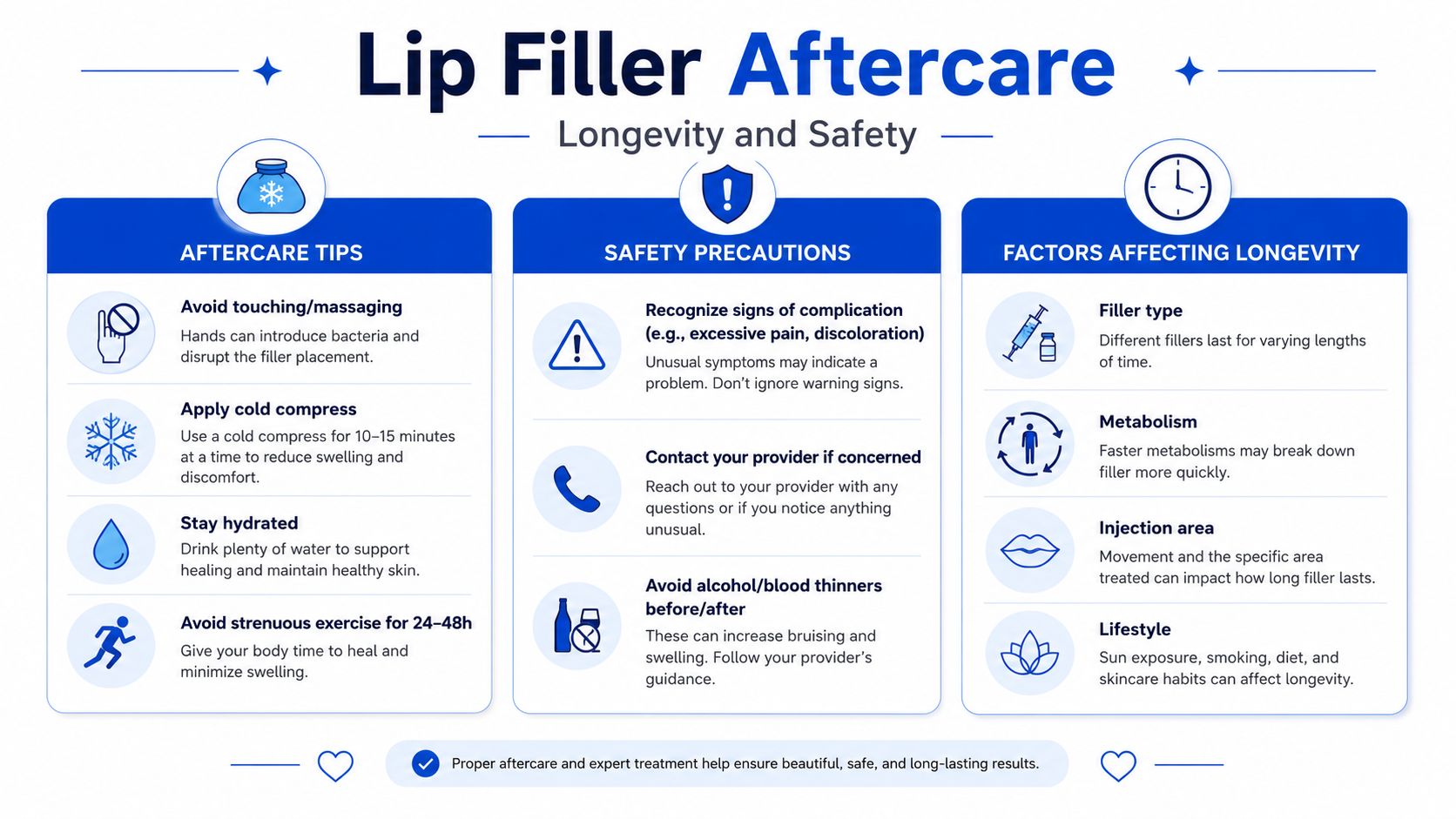
Lip Filler Aftercare Longevity and Safety
Once treatment is done, patients usually want to know three things. What should I do today? What's normal? How long will this last? Clear aftercare answers all three.
According to Cleveland Clinic, U.S. healthcare providers performed more than 2.1 million lip filler procedures in 2018, lip fillers typically last 12 to 18 months, and swelling usually improves within 24 to 48 hours though it can take up to a week to settle, as outlined in this Cleveland Clinic guide to lip fillers. A separate clinical-style overview notes that many initial lip filler sessions use about 0.5 to 1.0 mL, with visible effect commonly persisting about 6 to 12 months before enough metabolic breakdown occurs to consider maintenance, as described in this overview of lip filler volume and duration.
What to do after treatment
Aftercare is mostly about reducing irritation and giving the lips time to settle.
A simple checklist helps:
- Use cold compresses gently: This can help calm swelling in the early period.
- Keep the area clean: Try not to touch or press on the lips unnecessarily.
- Stay hydrated: Dry lips can feel tighter and more irritated after injections.
- Take a short pause from intense activity: Heavy exercise right away may worsen swelling for some people.
Patients also often ask about when they can judge whether they “need more.” Early touch-up decisions are where overfilling starts. If lips are still swollen, they're not ready for an honest volume assessment.
What is normal and what deserves a call
Normal short-term effects usually include tenderness, swelling, and sometimes bruising. Mild asymmetry can also happen early because one side may swell more than the other.
Call your provider promptly if something feels off in a way that seems beyond normal healing. Concerning symptoms are less about “my lips feel puffy” and more about severe pain, unusual discoloration, or anything that seems to worsen instead of improve.
A natural result doesn't just depend on how the lips look right after treatment. It depends on how they look once swelling resolves and whether the shape still feels balanced at follow-up.
Longevity also varies. Some people metabolize filler faster. Some want a tiny amount of maintenance before full fading. Others prefer to wait and reassess from baseline. A related treatment some patients also ask about for lip-area renewal is a chemical lip peel before and after overview, which addresses surface texture rather than filler volume.
The key is to think of lip filler as adjustable, not permanent. That's one reason conservative treatment plans tend to age better on the face.
Preview Your Look with the Entity Med AI Simulator
The hardest part of planning lip filler is that you're trying to make a decision about your own face using other people's photos. Even when those photos are honest, they still can't tell you exactly how a subtle border enhancement or a soft volume increase might look on your lip shape.
That's where preview technology becomes useful.

Why previews matter
Social content around lip filler is dominated by before and after photos, but educational quality is often weak. Expert guidance also notes that photos taken immediately after treatment can overstate fullness, which leaves many patients asking not just what they'll look like, but when the final result is visible. That gap is exactly where personalized previews can help, as discussed in this expert discussion of lip filler photos and expectations.
A preview doesn't replace medical judgment. It gives you a clearer visual starting point for conversation. That can be especially helpful if your goal is subtle and you're worried about crossing the line into “too much.”
How it helps the consultation feel clearer
At ProMD Health Columbia, the Entity Med AI Simulator can be used during consultation to preview possible aesthetic changes before treatment. That makes the conversation more concrete. Instead of saying “a little fuller, but natural,” you and your injector can react to a visual direction together.
That kind of collaboration helps with common patient concerns:
- Fear of going too big: A preview can support a more conservative plan.
- Trouble explaining your goal: Visual references make communication easier.
- Confusion from social photos: Personalized imaging is more relevant than scrolling strangers online.
- Need for reassurance: Seeing a possible outcome can make the decision feel less abstract.
Used well, preview technology doesn't promise an exact final photo. It helps align expectations, reduce guesswork, and make the plan feel made for your face.
How to Prepare for Your Lip Filler Consultation
A strong consultation starts before you walk in. The clearer you are about your goals, the easier it is for your injector to design something that fits your face and your comfort level.
You don't need perfect language. You just need honest preferences.
Bring goals not just screenshots
Photos can help, but they work better when paired with a reason. Instead of saying, “I want these lips,” try saying what you like about the photo.
For example:
- “I like the soft border definition.”
- “I want my upper lip to show a little more.”
- “I want hydration, not obvious size.”
- “I don't want a projected look from the side.”
That gives the injector something usable. It also helps avoid the trap of chasing a result that only works on a different face.
A few things to do before your visit:
- Review your priorities: Fullness, symmetry, definition, hydration, or restoration.
- Save inspiration carefully: Choose photos with neutral expression and consistent lighting.
- Know your limits: If you're nervous about looking overdone, say that early.
- Share your history: Mention prior filler if you've had it before.
“Natural” means different things to different people. The consultation is where that word gets translated into an actual plan.
Questions worth asking at your visit
Good consultations feel like two-way conversations. You should leave understanding not just what's possible, but why a provider recommends a certain approach.
Useful questions include:
| Question | Why it matters |
|---|---|
| What change do you think suits my anatomy? | This shows whether the plan is personalized |
| Would you suggest a conservative first session? | Helpful for first-timers and subtle goals |
| What will I look like during healing? | Sets expectations for the first week |
| When should I evaluate the result? | Helps prevent early worry or overcorrection |
If you're local to Columbia, Ellicott City, Clarksville, Laurel, or nearby Howard County communities, it also helps to know who you'll meet. Patients often feel more at ease when they know there's an experienced team behind the consultation process. Names such as Jennifer Aponte, PA-C, Sabina Sambat, NP, and Daisey Cormier, NP may be part of that care experience depending on scheduling and treatment planning.
The right appointment should feel calm, specific, and honest. You should leave with a plan that respects your anatomy, your timeline, and your comfort level. Lip filler before and after photos may bring you in the door, but a thoughtful consultation is what turns curiosity into a result you'll feel good about.
If you're thinking about lip enhancement and want a realistic, personalized plan, ProMD Health Columbia is a place to start. A consultation can help you sort through inspiration photos, understand the healing timeline, and decide whether a subtle or more defined result fits your features.

